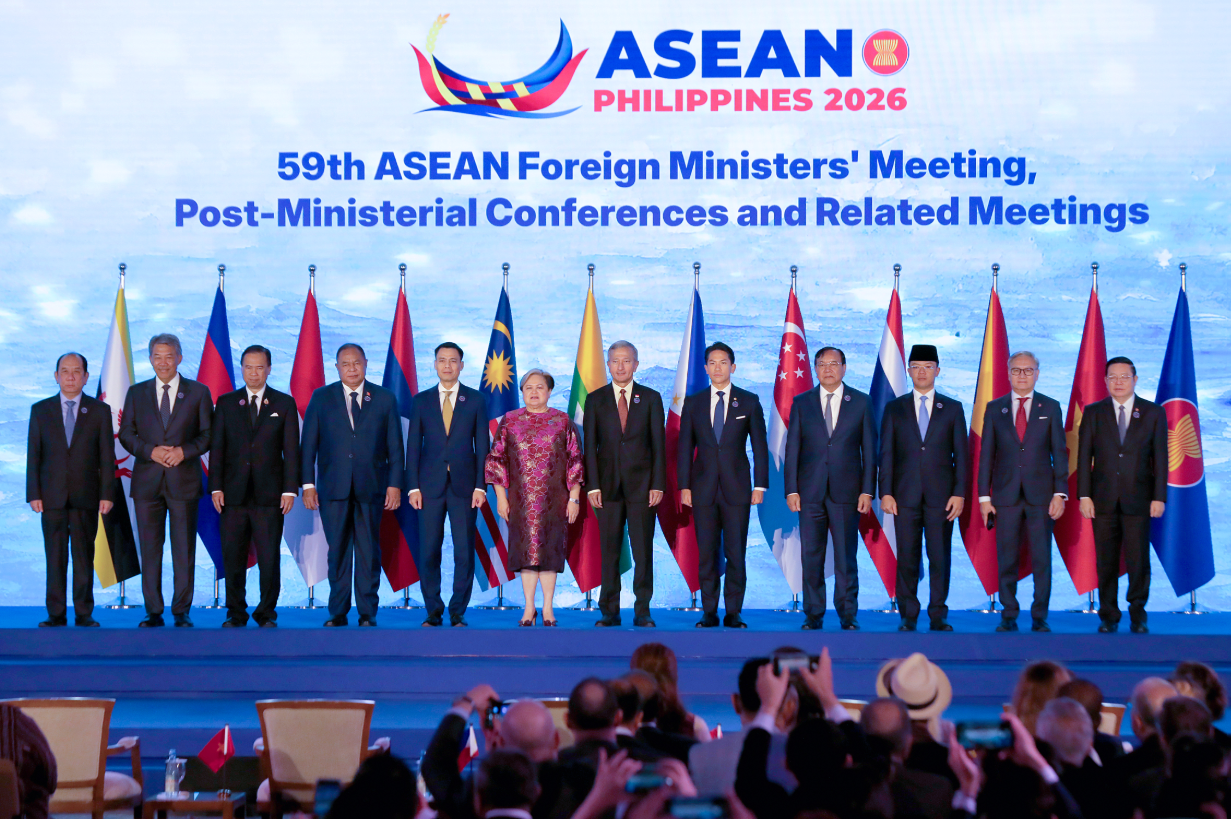
The 59th ASEAN Foreign Ministers’ Meeting and a parallel gathering of the Quad Foreign Ministers in Manila have reinforced the central role of ASEAN in maintaining regional stability while highlighting growing cooperation among Australia, India, Japan and the United States on security, economic resilience and emerging technologies.
Held under the Philippines’ 2026 ASEAN Chairmanship theme, “Navigating Our Future, Together”, the meetings brought together foreign ministers from ASEAN member states, dialogue partners and key Indo-Pacific stakeholders against a backdrop of heightened geopolitical tensions, including instability in the Middle East, maritime disputes in the South China Sea and the ongoing crisis in Myanmar.
ASEAN centrality remains the cornerstone
Throughout the ministerial meetings, ASEAN leaders reaffirmed the organisation’s commitment to ASEAN unity and centrality while advancing priorities focused on regional integration, economic resilience, food and energy security, digital transformation and the green economy.
Ministers discussed strengthening cooperation in emerging technologies, including artificial intelligence, supply chain resilience and digital trade, while reaffirming support for international law and the United Nations Convention on the Law of the Sea (UNCLOS). Particular attention was given to safeguarding freedom of navigation and ensuring the uninterrupted flow of maritime commerce through strategically important sea lanes.
The ministers also reiterated support for the implementation of the ASEAN Five-Point Consensus on Myanmar, calling for an immediate cessation of violence, the release of political prisoners, expanded humanitarian assistance and meaningful dialogue among all stakeholders.
Concerns over escalating conflict in the Middle East also featured prominently. ASEAN foreign ministers warned that renewed hostilities and disruption to the Strait of Hormuz could have significant consequences for global energy markets, international trade and regional food security, reinforcing calls for restraint and peaceful resolution of disputes.
Quad reinforces support for ASEAN
On the sidelines of the ASEAN meetings, Australian Foreign Minister Penny Wong joined United States Secretary of State Marco Rubio, India’s External Affairs Minister Dr. S. Jaishankar and Japan’s Foreign Minister Toshimitsu Motegi for the latest Quad Foreign Ministers’ Meeting.
The four ministers issued a joint statement reaffirming their “unwavering support for ASEAN unity and centrality” and their shared commitment to a free, open and inclusive Indo-Pacific. Rather than presenting the Quad as an alternative regional institution, the ministers emphasised that Quad initiatives are intended to complement ASEAN-led regional architecture and support practical implementation of the ASEAN Outlook on the Indo-Pacific (AOIP).
The ministers agreed to deepen cooperation across four principal areas:
- maritime and transnational security;
- economic prosperity and resilience;
- critical and emerging technologies; and
- humanitarian assistance and disaster response.
The joint statement described ASEAN as indispensable to regional stability and economic growth, reaffirming that cooperation with Southeast Asian nations remains central to the Quad’s strategic engagement across the Indo-Pacific.
Technology emerges as a strategic priority
While traditional security issues dominated discussions, technology cooperation featured prominently across both ASEAN and Quad meetings.
ASEAN ministers discussed expanding collaboration in artificial intelligence, digital economies and resilient supply chains as part of broader efforts to strengthen economic integration and improve regional competitiveness.
Similarly, the Quad ministers identified critical and emerging technologies as a key area for practical cooperation, recognising that technological leadership increasingly underpins economic security, defence capability and national resilience.
For Australia, this aligns closely with broader government priorities surrounding trusted technology partnerships, cyber resilience, critical infrastructure protection and secure supply chains across the Indo-Pacific.
Maritime security remains a common concern
Growing tensions in the South China Sea continued to influence discussions throughout the week.
ASEAN ministers reaffirmed the importance of maintaining freedom of navigation, respecting international law and progressing negotiations towards an effective Code of Conduct between ASEAN and China. Recent incidents involving Chinese and Philippine vessels reinforced concerns about the risk of escalation in disputed waters.
The Quad similarly emphasised that peace and stability across the Indo-Pacific maritime domain underpin regional prosperity, with practical cooperation focused on maritime awareness, resilience and security partnerships.
Australia strengthens regional engagement
Australia used the meetings to reinforce its Comprehensive Strategic Partnership with ASEAN.
Foreign Minister Penny Wong reaffirmed Australia’s support for ASEAN-led institutions and highlighted Australia’s commitment to working with Southeast Asian partners on regional security, economic development and emerging technologies. Indonesian Foreign Minister Sugiono likewise stressed that the ASEAN-Australia partnership must continue adapting to increasingly complex regional challenges while preserving regional stability.
Strategic implications
Taken together, the ASEAN Foreign Ministers’ Meeting and the Quad Foreign Ministers’ Meeting illustrate an increasingly integrated Indo-Pacific security architecture.
ASEAN continues to provide the primary forum for regional diplomacy, consensus-building and multilateral engagement, while the Quad is increasingly positioning itself as a complementary mechanism capable of delivering practical initiatives in areas such as critical technologies, cyber security, maritime security and resilient infrastructure.
For Australia, the meetings reaffirm the importance of balancing strong alliances with continued investment in ASEAN centrality. As strategic competition intensifies across the Indo-Pacific, the success of this approach will likely depend on maintaining trusted partnerships that support regional stability while advancing cooperation in emerging technologies, economic resilience and collective security