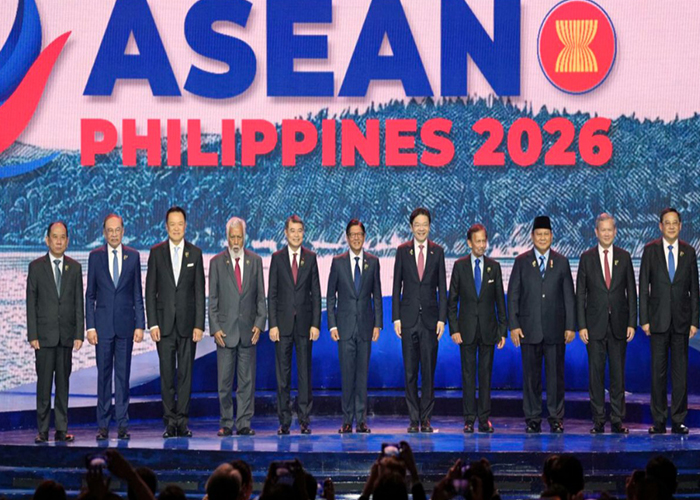
Southeast Asian leaders have gathered in Manila for the 49th ASEAN Summit and Related Summits, with maritime security, regional stability, economic resilience and transnational crime among the major priorities as the Philippines concludes its 2026 chairship of the regional organisation.
Hosted by Philippine President Ferdinand Marcos Jr. from 15 to 17 November, the summit brings together leaders of the Association of Southeast Asian Nations (ASEAN) and dialogue partners, including Australia, China, India, Japan, South Korea and the United States.
At least 19 world leaders and heads of international institutions were confirmed to participate, reflecting the growing importance of Southeast Asia in regional security, international trade and strategic competition across the Indo-Pacific.
The Philippines is hosting the meetings under the theme Navigating Our Future, Together, with its chairship priorities centred on peace and security, economic prosperity and people empowerment.
The summit comes amid continuing tensions in the South China Sea, the conflict in Myanmar, uncertainty surrounding global energy supplies and increasing concern about cross-border criminal activity, including online scams.
Philippine Foreign Affairs Secretary Ma. Theresa Lazaro acknowledged the difficult international environment confronting ASEAN during the opening of the Foreign Ministers’ Meeting on 14 November.
Lazaro said the region had faced unprecedented challenges, including the Middle East conflict, natural disasters and pressures on international cooperation.
The Philippines has sought to position ASEAN as a platform for constructive dialogue while encouraging practical measures to address shared economic and security challenges.
Marcos is chairing the leaders’ plenary and retreat sessions, alongside meetings with ASEAN parliamentarians, business representatives and youth organisations.
The summit programme also includes discussions with external dialogue partners and the 21st East Asia Summit, bringing together major regional powers to consider strategic and economic developments.
A central security issue is the continuing dispute over maritime rights and territorial claims in the South China Sea.
ASEAN members are expected to review progress towards a Code of Conduct with China, including arrangements intended to manage maritime incidents, reduce the risk of confrontation and support peaceful dispute resolution.
The negotiations remain particularly important to the Philippines, which has experienced repeated confrontations involving Chinese vessels in disputed waters.
ASEAN’s approach has generally emphasised international law, freedom of navigation and the peaceful settlement of disputes, including reference to the United Nations Convention on the Law of the Sea.
However, ASEAN members maintain different relationships with China, and achieving consensus on maritime security remains a significant diplomatic challenge.
The summit is also considering the proposed establishment of an ASEAN Maritime Centre, with foreign ministers tasked with examining its concept and terms of reference.
The proposed centre would provide an additional institutional mechanism for maritime cooperation, although its eventual responsibilities and operational arrangements remain subject to agreement.
Myanmar is another major focus following years of conflict and limited progress in implementing ASEAN’s Five-Point Consensus, adopted in April 2021.
On 15 November, ASEAN leaders adopted a review and decision concerning implementation of the consensus, expressing deep concern about continuing conflict and the humanitarian situation.
The leaders called for substantive progress and emphasised that ASEAN’s engagement with Myanmar should be calibrated according to developments on the ground.
Myanmar is represented at the summit by a senior foreign ministry official rather than its political leadership.
The decision reflects ASEAN’s continuing efforts to maintain diplomatic engagement while responding to the failure to achieve meaningful progress towards ending violence and establishing an inclusive political dialogue.
Beyond traditional security concerns, ASEAN leaders are examining the growing economic and social consequences of transnational organised crime.
Philippine officials identified online scams as a priority issue ahead of the summit, alongside food security, energy security and migrant worker protection.
ASEAN spokesperson Dominic Xavier Imperial said the meetings were expected to produce measures addressing transnational crime and online fraud, which have become increasingly significant challenges for governments and law enforcement agencies across Southeast Asia.
The expansion of cross-border scam operations has also highlighted the intersection between organised crime, cyber-enabled fraud, human trafficking and financial crime.
For regional governments, stronger cooperation on intelligence sharing, investigations, financial monitoring and victim protection will be important to disrupting these activities.
Energy security has also become a prominent issue as instability in the Middle East affects global markets and exposes the dependence of many Southeast Asian economies on imported fuel.
Imperial indicated that ASEAN leaders were expected to consider additional measures addressing energy supply pressures and their wider economic consequences.
Food security, regional supply chains and the protection of migrant workers are also expected to feature in the summit’s economic and social discussions.
The summit is expected to produce more than 100 outcome documents across ASEAN’s political-security, economic and socio-cultural pillars, together with its relationships with external partners.
Among the anticipated developments is the handover of work on the ASEAN Digital Economy Framework Agreement, intended to strengthen regional digital integration and facilitate cross-border economic activity.
Digital connectivity, trusted infrastructure and regulatory cooperation are becoming increasingly important as Southeast Asian economies expand their reliance on cloud services, electronic commerce, digital payments and artificial intelligence.
For Australia, the summit provides an opportunity to reinforce its Comprehensive Strategic Partnership with ASEAN and strengthen cooperation on regional security, trade, economic resilience and emerging technologies.
Australian participation in the ASEAN-Australia Summit and related meetings is also significant against the backdrop of expanding defence cooperation, maritime security arrangements and regional competition over critical infrastructure investment.
The Philippines is scheduled to hand over the ASEAN chairship to Singapore at the conclusion of the meetings on 17 November.
The transition will place Singapore in a central role in coordinating ASEAN’s diplomatic and economic agenda in 2027.
The outcomes of the Manila summit will be closely watched for evidence of practical progress on maritime security, Myanmar, transnational crime and economic integration.
For ASEAN, the central challenge remains translating consensus-based diplomacy into coordinated regional action while maintaining relationships with major powers whose strategic interests increasingly overlap in Southeast Asia.