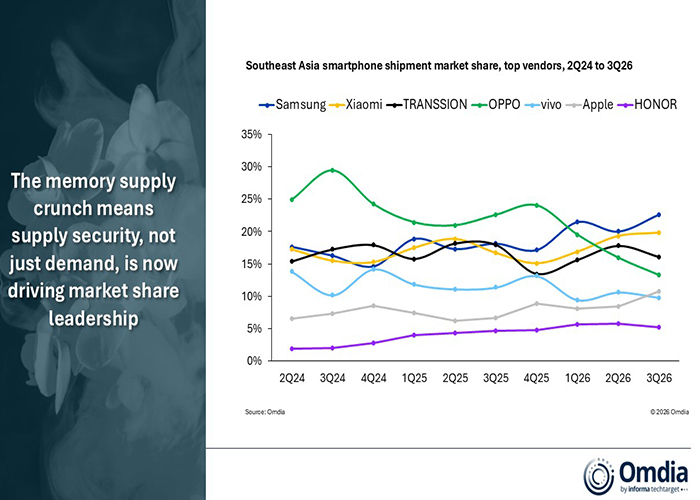
Southeast Asia’s smartphone market contracted 36% year-on-year in the third quarter of 2026, with shipments falling to 16.5 million units as memory supply shortages and higher component costs limited vendors’ ability to ship devices, according to new research from Omdia.
Omdia said the fall in volumes continued a decline seen in the first half of 2026. Despite the shipment drop, market value was down just 1% year-on-year, while average selling prices rose 53%, indicating vendors have lifted prices to manage supply pressures.
Among the region’s largest vendors, Samsung remained the top supplier in 3Q26, with shipments down 20% to 3.7 million units. Omdia attributed part of the decline to memory constraints and Samsung’s third-quarter focus on higher-end foldables.
Xiaomi’s shipments fell 24% in the quarter, although Omdia reported a 55% increase in retail average selling price helped offset the impact on market value. Xiaomi also took the leading position in Vietnam for the first time, with shipments there growing 50% year-on-year, which Omdia said was driven by mass-market models.
TRANSSION recorded a 42% shipment decline and a 16% regional market share, according to the research, but retained leading positions in the Philippines and Indonesia. Omdia said the company has reduced the number of variants in new model launches in response to memory supply constraints.
OPPO, including realme, saw shipments drop 62% to 2.2 million units, placing it fourth in the region. Omdia linked the decline to a withdrawal from the sub-$100 segment as memory costs increased, noting the vendor’s entry-level A6c 4G now starts at about $140 in most Southeast Asian markets, while shipments of devices priced above $400 rose more than 50% led by the Reno 16 series.
Apple was the only vendor in Omdia’s top five to post shipment growth, rising 4% year-on-year, supported by performance in Malaysia and Vietnam. Omdia said Apple’s higher-priced portfolio left it less exposed to the supply pressures affecting vendors selling devices below $200, and added that buy now, pay later services contributed to affordability for some buyers.
Omdia’s Sheng Win Chow said the shipment decline should not be assumed to reflect weaker demand. “Shipment declines this quarter should not automatically be interpreted as weakening demand,” said Sheng Win Chow, Senior Analyst at Omdia. “Vendors can still supply devices across almost every price segment above $100, but they can no longer offer the same memory and storage specifications at previous price points. The impact on consumer demand will depend on how buyers respond to these changes and whether they consider the trade-offs acceptable. As a result, vendors are focusing their marketing on the practical benefits of new devices rather than headline RAM and storage specifications.”
Chow added that tightening memory supplies were forcing vendors to reassess product positioning and profitability, pointing to vivo’s move away from the ultra-low-end segment. “Omdia estimates that vivo’s 2026 year-to-date (YTD) shipments fell 33% while its ASP jumped 37%. The ultra-low-end segment typically operates on narrow margins and relies heavily on subsidies and discounting. Reducing exposure to this segment can therefore help vendors improve profitability, even as shipment volumes decline.”
On market-level performance, Omdia said Vietnam was the only Southeast Asian country to show shipment growth in 3Q26, rising 1% year-on-year, while other markets recorded double-digit declines. “Vietnam was the only Southeast Asian market to record growth in 3Q26, with shipments increasing 1% YoY. All other Southeast Asian markets recorded double-digit declines, with shipments in Indonesia, the Philippines, Malaysia and Thailand falling by more than 30%,” said Le Xuan Chiew, Research Manager at Omdia.
Chiew attributed Vietnam’s relative resilience to macroeconomic conditions, including foreign direct investment, manufacturing activity and exports linked to global demand for AI hardware. Omdia also said HONOR improved its standing in more developed markets, reaching second place in Malaysia and third in Singapore by shipments for the first time, which the firm linked to a focus on premium mid-range devices and wider presence in telco operator channels.