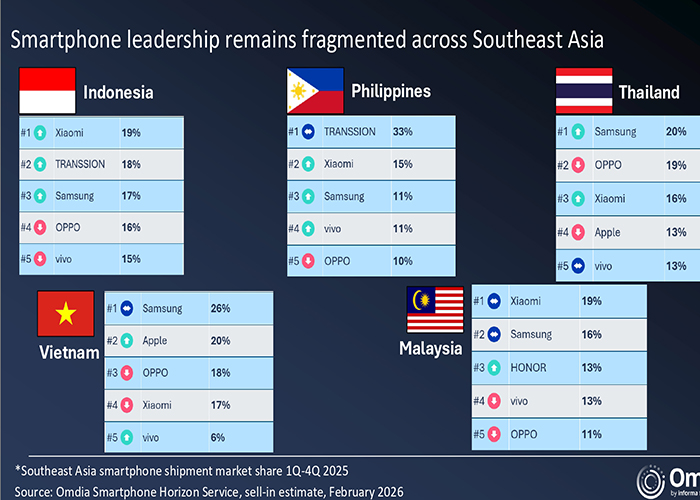
Southeast Asia’s smartphone market declined slightly in 2025, with total shipments reaching 100 million units, down 1% year-on-year, according to new data from Omdia.
The research firm said weaker performance in the first three quarters weighed on the annual result, although the market returned to growth in the fourth quarter. Shipments in 4Q25 rose 2% year-on-year to 25.8 million units, ending three consecutive quarters of contraction.
Samsung regained the top position in the region for the full year, shipping 17.9 million units, up 5% year-on-year, to secure an 18% market share. In the fourth quarter, Samsung shipped 4.2 million units, representing a 19% year-on-year increase and a 17% quarterly share. Omdia attributed the late-year momentum in part to the Galaxy A17 series in the affordable segment.
Xiaomi ranked second for the year, with shipments rising 4% to 17.0 million units and a 17% share. In 4Q25, Xiaomi shipped 3.9 million units, accounting for 15% of the market. Omdia noted that a larger share of its new portfolio had already been shipped in the previous quarter.
TRANSSION placed third in full-year volumes despite an 8% decline in shipments to 16.3 million units, with share easing to 16%. In the fourth quarter, the vendor shipped 3.5 million units, down 25% year-on-year, reflecting shipment corrections following earlier expansion.
OPPO shipped 14.7 million units in 2025, down 16% year-on-year, for a 15% share. However, it recorded the second-highest quarterly volume in 4Q25 with 4.1 million units, up 4% year-on-year, supported by its Reno 15 and updated A-series models.
vivo completed the top five, with shipments declining 6% to 11.9 million units and a 12% share. In the fourth quarter, vivo shipped 3.4 million units, down 7% year-on-year, although its average selling price increased 11%, reflecting a shift toward higher-value models.
Omdia said vendor strategies are increasingly shaped by rising component costs and margin pressure. Memory and storage now account for more than 30% of the bill of materials for smartphones priced below US$200, a segment that represents more than 60% of shipments in Southeast Asia. Analysts expect cost inflation to become more visible from mid-2026 as higher component prices feed through to device pricing.
Recent product launches, including Samsung’s Galaxy A07 5G and Xiaomi’s Redmi Note 15 series, have been priced above their predecessors, signalling potential upward pressure on entry-level devices.
Omdia analysts said vendors are moving toward more value-led channel strategies, focusing on portfolio mix and sell-through quality rather than relying on aggressive inventory loading and rebates to drive volume.