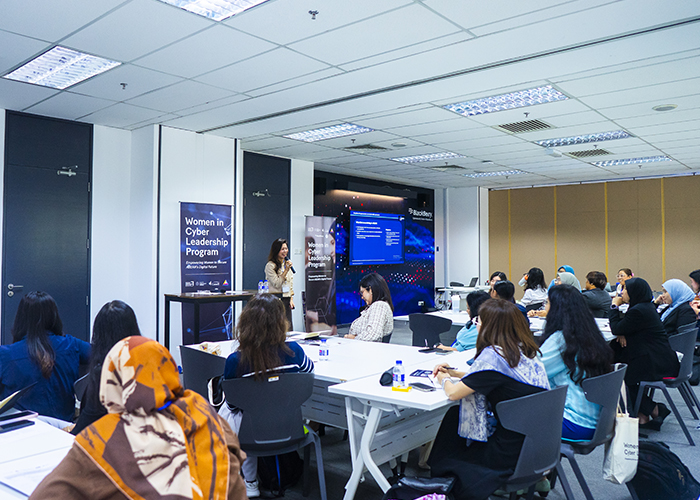
Malaysia has hosted the inaugural Women in Cyber Leadership Program, bringing together professionals from across ASEAN in a bid to address the leadership gap in cybersecurity across the Indo-Pacific.
The five-day program, delivered from January 26–30 at the MCMC and BlackBerry Cybersecurity Centre of Excellence (CCoE), was conducted in collaboration with Global Affairs Canada and Rogers Cybersecure Catalyst at Toronto Metropolitan University.
More than 25 women professionals from ASEAN member states including the Philippines, Thailand, Malaysia and Singapore were competitively selected to participate in the fully funded program. Participants represented a range of sectors and undertook training focused on cyber risk, governance and leadership, alongside practical and professional skills development.
The initiative forms part of a strategic co-funding arrangement under the Government of Canada’s Indo-Pacific strategy and was first announced during the 47th ASEAN Summit in October 2025. It is intended to strengthen cybersecurity capacity and leadership capability across the region.
Jaclyn Sim, Senior Manager of Training at the MCMC and BlackBerry CCoE, said the program aims to support mid-career women in progressing into leadership roles.
“This unique public-private-academia initiative underscores the MCMC and BlackBerry CCoE’s commitment to grow a highly skilled and diverse cyber workforce, while supporting Malaysia as a leading regional hub of excellence for cybersecurity capability development across ASEAN,” Sim said.
Trish Dyl, Director of Skills Development and International Programs at the Catalyst, highlighted the importance of diversity in tackling increasingly complex cyber threats.
“Women are underrepresented at the leadership table, so working together across borders and industry in this way is important to turn the dial forward, while supporting cyber-resilience and capacity building for Malaysia and ASEAN,” she said.
Raymond Siva, a digital strategy and future technology investment consultant, said rising geopolitical tensions have elevated the need for cybersecurity to be embedded within organisational strategy rather than treated as a compliance function.
“Strengthening digital literacy across our workforce, diversifying our digital supply chains, and advancing regional collaboration will be essential to ensuring that ASEAN’s digital economy grows in a way that is not only innovative and competitive, but also resilient, secure, and inclusive,” Siva said.
Participants said the program provided practical insights and regional perspectives on cyber risk management.
Nurul Aisyah Sim Abdullah, Director of Audit and Compliance Division at Malaysia’s National Cyber Security Agency (NACSA), said the course offered exposure to regional cybersecurity best practices and peer exchange.
Juliana Jamil, Principal Assistant Director at the Malaysian Maritime Enforcement Agency, said engagement with regional counterparts reinforced the importance of policy alignment in strengthening cross-border cyber readiness.
Esther Soh Peck Woon, Senior Assistant Director at the Cyber Security Agency of Singapore, said the course helped strengthen her understanding of how cyber risk decisions affect operations and trust.
The Women in Cyber Leadership Program positions Malaysia’s Cybersecurity Centre of Excellence as a regional training hub, as ASEAN economies continue to expand their digital infrastructure amid rising cyber threats and increasing demand for skilled leadership.