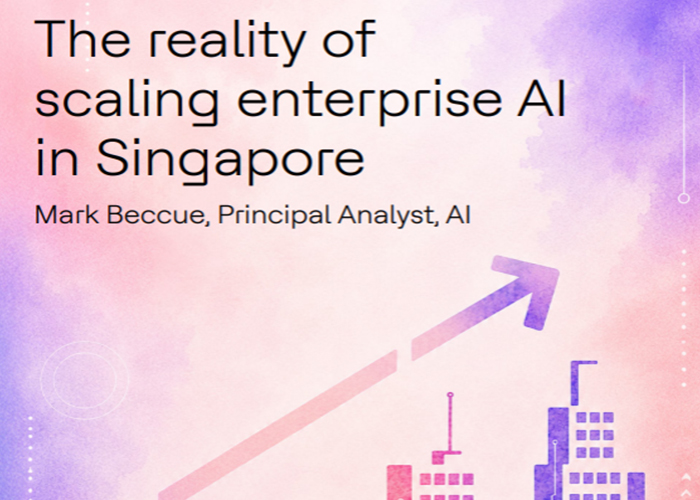
HCLTech has released a Singapore-focused report examining how enterprises are scaling AI as adoption moves into mission-critical business use cases, highlighting gaps between deployment ambitions and operational readiness.
The report, The reality of scaling enterprise AI in Singapore, produced by HCLTech in partnership with research firm Omdia, found 70% of Singapore leaders believe all competitors in their industry will be using autonomous AI systems for mission-critical work within the next 12 months.
Despite that expected acceleration, respondents indicated that supporting infrastructure and processes are lagging. The study found 81% of respondents said both legacy and already-modernised applications require significant overhauls to support AI functionality, while 49% identified insufficient monitoring and auditing processes as a leading governance barrier.
According to the report, generative and agentic AI are already being used across software development (93%), IT operations (86%) and operational environments (77%).
The Singapore findings were based on 43 respondents from organisations with annual revenues of US$1 billion or more, as part of a wider study of 467 respondents across the Americas, Europe and APAC.
HCLTech Senior Vice President, ASEAN, Sandeep Sarkar said organisations needed to focus on modernising applications and data and strengthening governance as AI moves from pilots into day-to-day operations.
“AI in Singapore is moving into a more serious phase, with 70% of leaders saying every competitor in their industry will be using autonomous AI for mission-critical work within the next 12 months,” Sarkar said. “There is a real opportunity here, but speed on its own will not deliver value. The organisations that get ahead will be the ones that modernise their applications and data, strengthen governance, and make AI part of how the business runs every day, rather than treating it as a set of isolated pilots.”
The report also pointed to demand for external support, finding 86% of Singapore organisations are seeking consultation to address AI skills gaps and accelerate execution, while 77% said they need help distinguishing proven solutions from “vaporware.”
As AI deployments expand into more critical processes, the report found responsible AI considerations are influencing enterprise decisions, with 81% of respondents saying these factors moderately or significantly affect deployment decisions, shaping architecture, timelines and scope.
You can read the full report here.